
Practical guide: how to serve, store and choose
All this history flows into some very concrete decisions: what temperature to serve at, which glass to use, how to store the bottle once it’s open. Here’s the essential.
Serving temperature
Temperature changes how a wine smells, tastes and feels. A wine served too cold may appear muted, acidic or structurally closed; served too warm, it may seem alcoholic, heavy and less precise. The objective isn't to hit one perfect number, but to start within an appropriate range and let the wine evolve naturally in the glass.
Why the range changes. Sparkling wine: lower temperatures help retain dissolved carbon dioxide and preserve freshness; more complex sparkling wines benefit from slightly higher temperatures because their aromas and texture become easier to perceive.
White and rosé: light, acidic wines generally benefit from cooler service; richer whites and structured rosés should be served slightly warmer so texture and complexity aren't suppressed. Red: "room temperature" is a historical expression associated with cooler European interiors, not a modern room at 23–28 °C — most reds benefit from light cooling before service. Fortified wine: can't be treated as one category — Fino Sherry, Tawny Port, Vintage Port, Madeira and sweet Muscat-based wines differ greatly in sweetness, oxidation, alcohol, aromatic intensity and service temperature.
Approximate domestic cooling times, starting from around 22 °C:
These times are estimates — refrigerator power, bottle thickness, starting temperature and ambient conditions all affect cooling speed. Practical rule: begin slightly cooler than the ideal service temperature, since wine warms quickly after pouring.
Glasses: a shape for every wine
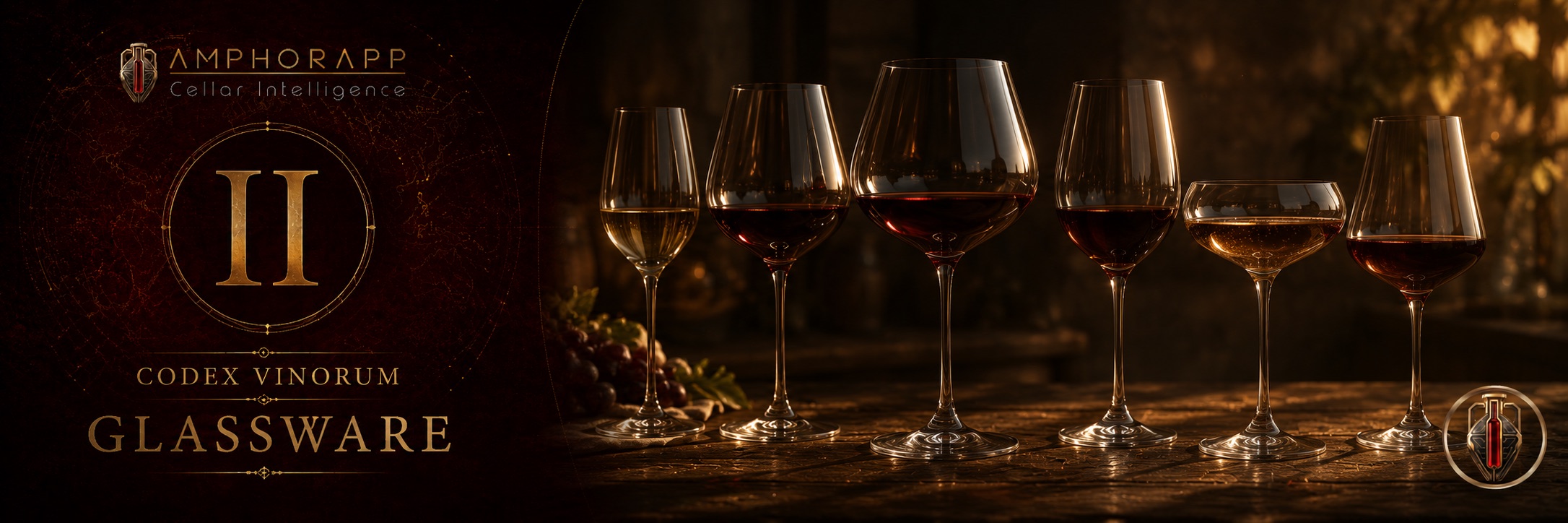
Every glass shape solves a specific physical problem, not an etiquette rule: the wide bowl of a red wine glass concentrates more complex aromas near the nose; the long stem keeps hand heat from warming a white wine; the narrow rim of a sparkling glass holds the bubbles longer; the more closed bowl of a rosé glass balances freshness with a thread of aromatic complexity.
Day to day, nobody needs eleven different glasses at home — Amphorapp's cellar keeps the profile of every label, but if you're only buying two glasses, pick one with a large bowl (for reds and full-bodied whites) and another narrower and taller (for light whites, rosés and sparkling wines); the rest is experimentation and personal taste.
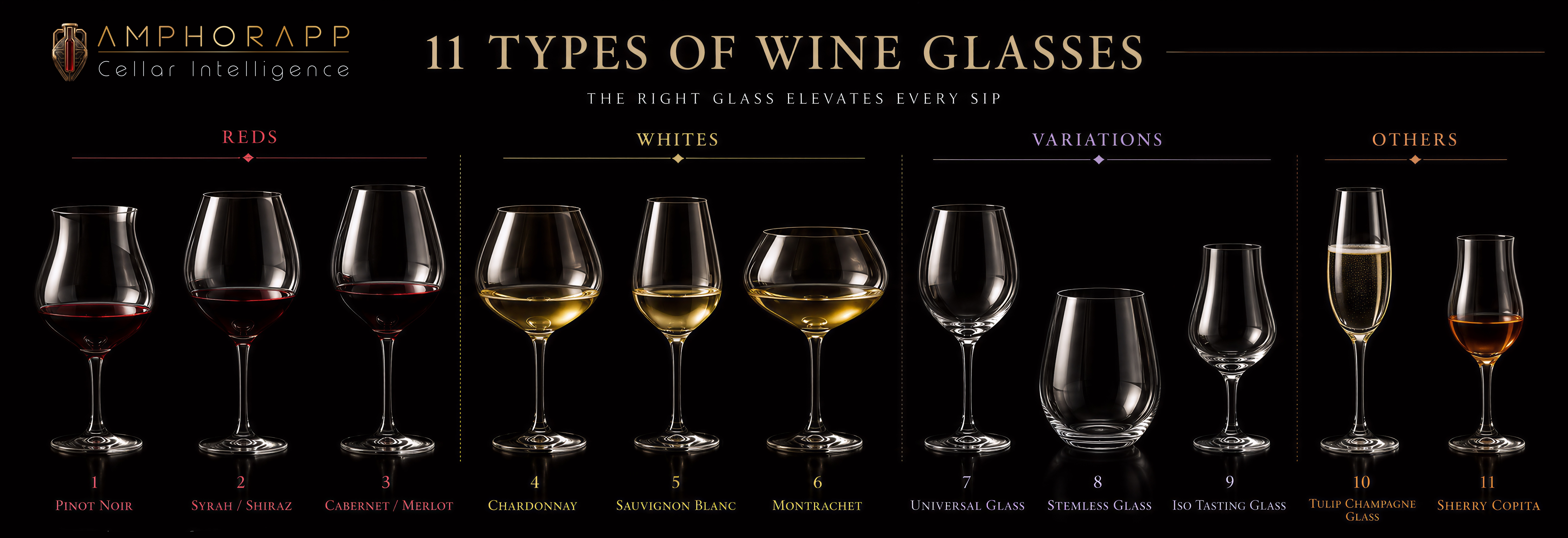
From the wide bowl of the Pinot Noir glass, which brings complex aromas closer to the nose, to the narrow Sherry copita, which concentrates intense notes in a small volume — each shape answers a specific physical need: a larger bowl for full-bodied reds and rich whites, a longer stem to keep the hand away from the liquid in light whites and sparkling wines, a tighter rim to retain bubbles. None of this is a hard rule — they’re optimizations that help you taste what’s already in the glass.
The height of the stem tells a story of its own, and it has a purely physical explanation: the human hand sits at around 37 °C, well above the ideal temperature for almost any wine — holding the bowl directly transfers that heat to the liquid within minutes, speeds up the evaporation of the most volatile aromas, and leaves the taste “warmer” and less fresh than it should be. That’s why light whites, sparkling wines and rosés come in long-stemmed glasses: the distance keeps the hand out of reach of the bowl.
Fortified and dessert wines, served in smaller pours and at a naturally higher temperature, tolerate — and by tradition even use — much shorter stems. The sommelier’s rule of thumb sums it all up: prefer holding by the stem (or the foot) over the bowl, and set the glass down on the table between sips. This isn't an absolute rule — stemless glasses and casual settings naturally call for different handling.
Always leave empty space
Technical tasting: 60–90 ml. Standard table service: 120–150 ml. Fortified and dessert wine: 45–90 ml. Avoid filling beyond the glass's widest point — headspace is essential for swirling and aromatic concentration.
No residue, no odor
Wash with a mild, unscented detergent, rinse thoroughly, and dry with a clean, odor-free microfiber cloth. Don't store glasses next to spices, cleaning products or strong odors, and never use a glass that smells of cardboard, cupboard, soap or damp fabric — for sparkling glasses, detergent film can interfere with bubble formation.
A home collection doesn't need eleven specialized glasses. Two shapes cover almost every situation: a medium-large universal glass for reds, structured whites and complex rosés, and a smaller tulip-shaped glass for light whites, rosés and sparkling wines.
In short: the correct glass helps physically (aroma concentration, temperature control, bubble retention), but it is never an obligation. Two well-chosen shapes already cover almost every real-life situation. Everything beyond that is personal preference and experimentation.
Bottles: from Bordeaux to the amphora
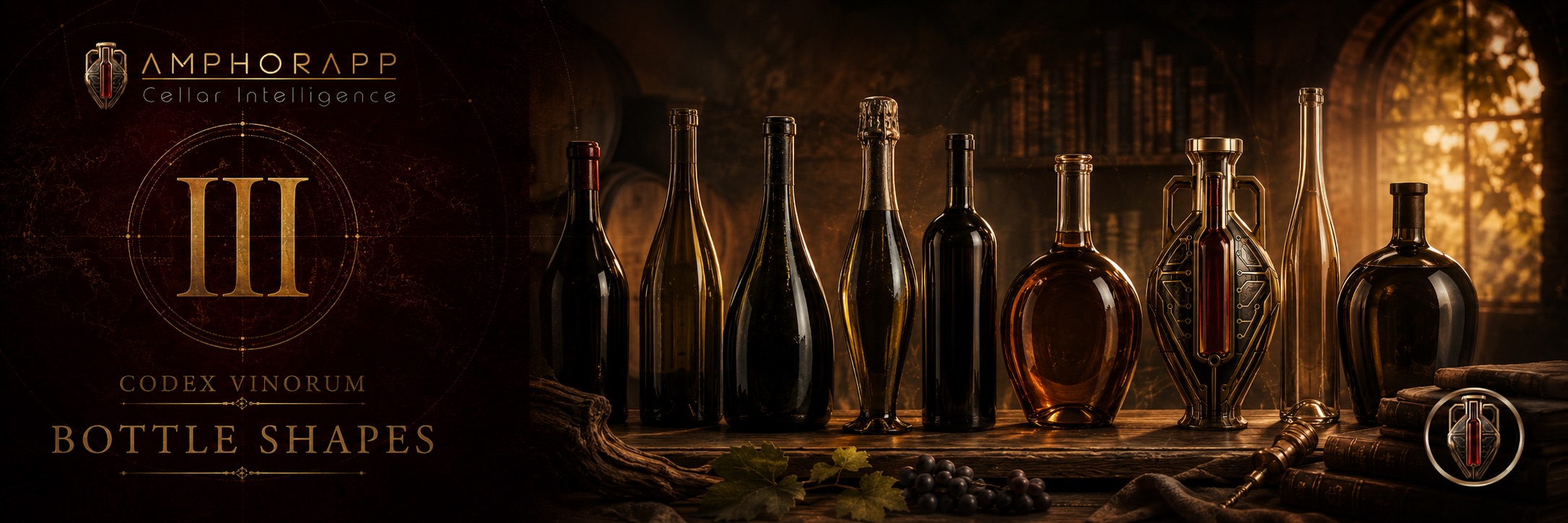
When you scan a label in Amphorapp, it's the producer and appellation that open the bottle's real file — but the glass itself already hints at style, shaped by centuries of regional habit more than any fixed rule. The Bordeaux bottle, with straight shoulders, is the most common in the world.
The Burgundy bottle, with a softer silhouette, is traditional for Pinot Noir and Chardonnay. The Rhine bottle, tall and slender, appears on German and Alsatian whites. And, closing the circle we opened this story with, the amphora-shaped bottle — still used today by some producers, especially with the Verdicchio grape, in Italy — is the most direct reminder that we’re drinking from a thousands-year-old tradition.
From Bordeaux to the amphora: every silhouette carries a piece of the regional history that shaped it.
Bottle anatomy
Guides the pour
Guides pouring and holds the closure — cork, capsule or screwcap.
Connects neck to body
In bottles with pronounced shoulders (like Bordeaux), it may help retain sediment when poured carefully.
Contains the wine
Determines most of the bottle's volume.
Not a sign of quality
The indentation at the base can improve structural strength and manufacturing stability. A deep punt is not evidence of superior wine.
Closures
Traditional and elastic
Suitable for long-term aging when sound. Performance varies with cork quality and storage history.
Treated components
Manufactured from treated cork components to provide greater consistency.
No cork-taint risk
Avoids the cork defect, though oxygen transmission and aging performance vary by product.
Not a lower-quality sign
Provides reliable closure, suitable for both youthful and age-worthy wines — it isn't evidence of lower quality.
Reusable and neutral
Chemically neutral, with relatively limited commercial adoption.
From production to final seal
Used during sparkling-wine production and increasingly retained as the final closure on some wines.
Heavy bottles require more glass and increase transport emissions — bottle weight doesn't guarantee quality. A technically serious guide distinguishes luxury perception from environmental performance, and encourages lightweight glass, recycled content, local bottling where appropriate, reusable packaging and efficient bottle formats.
How to store (and how not to)
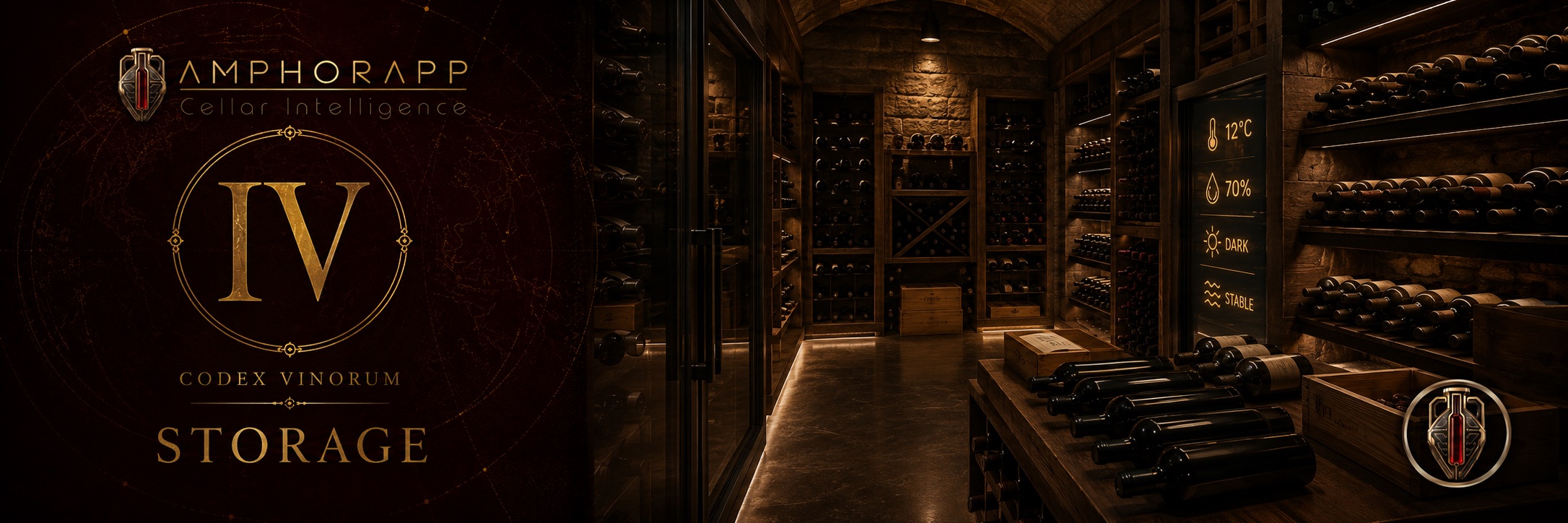
Wine evolves through chemical reactions that continue after bottling. Heat, light, oxygen exposure and unstable conditions can accelerate that evolution or cause premature deterioration. In most homes, the biggest risks are: excessive heat, repeated temperature fluctuations, direct sunlight, closure failure or leakage, extreme dryness or condensation during prolonged storage, persistent vibration, and strong environmental odors or chemical contamination.
Stable, between 10 and 15 °C
Around 12–13 °C is a useful reference, not a magical requirement — a stable 15 °C is usually preferable to a room moving repeatedly between 10 and 25 °C. Avoid the kitchen, next to ovens or fridges, exterior walls exposed to sun, garages with seasonal extremes, car trunks, uninsulated attics and display shelves under strong lighting.
Little to none
Light — especially UV — speeds up unwanted chemical reactions in wine, and sparkling and light-colored wines are especially vulnerable. Dark hallways and cabinets work better than shelves in the living room or display lighting.
Between 60% and 75%
Practical range for bottles sealed with natural cork. Excessively dry air can contribute to cork deterioration and label damage; excessive humidity can encourage mold and label degradation. It's less critical for screwcaps, glass stoppers, synthetic closures and short-term storage.
The less, the better
Persistent vibration may disturb sediment and, over time, influence aging reactions — its practical importance in ordinary homes is less established than the effects of heat and light. Avoid storing bottles directly on vibrating machinery, beside compressors, under frequently used stairs, or on unstable shelving.
Bottle position also depends on the closure. Natural cork: storing horizontally remains practical for long-term organization and may help maintain contact between wine and closure.
Screwcap, glass or synthetic closure: these bottles may be stored upright, with no need to keep a cork wet. Sparkling wine: either position may be used, depending on producer recommendation, duration and cellar organization. Short-term storage (consumed within months): position generally matters less than temperature and light.
Don't store wine beside paint, fuel, solvents, pesticides, household cleaning products, strong spices, or moldy or damp materials — a sound closure provides substantial protection, but a clean environment is still preferable for long-term storage.
Short-term priorities
Cool location, darkness, limited temperature variation, safe organization and easy access.
Long-term priorities
Stable temperature, controlled humidity, low light, closure inspection, provenance records, minimal disturbance, inventory monitoring and drinking-window assessment.
Not every wine improves with age — most are made for consumption while young. Aging potential depends on the interaction of acidity, tannin, sugar, alcohol, concentration, grape variety, winemaking, oxygen exposure, closure, vintage and storage history. Age alone does not indicate quality.
After opening: preserving what's left
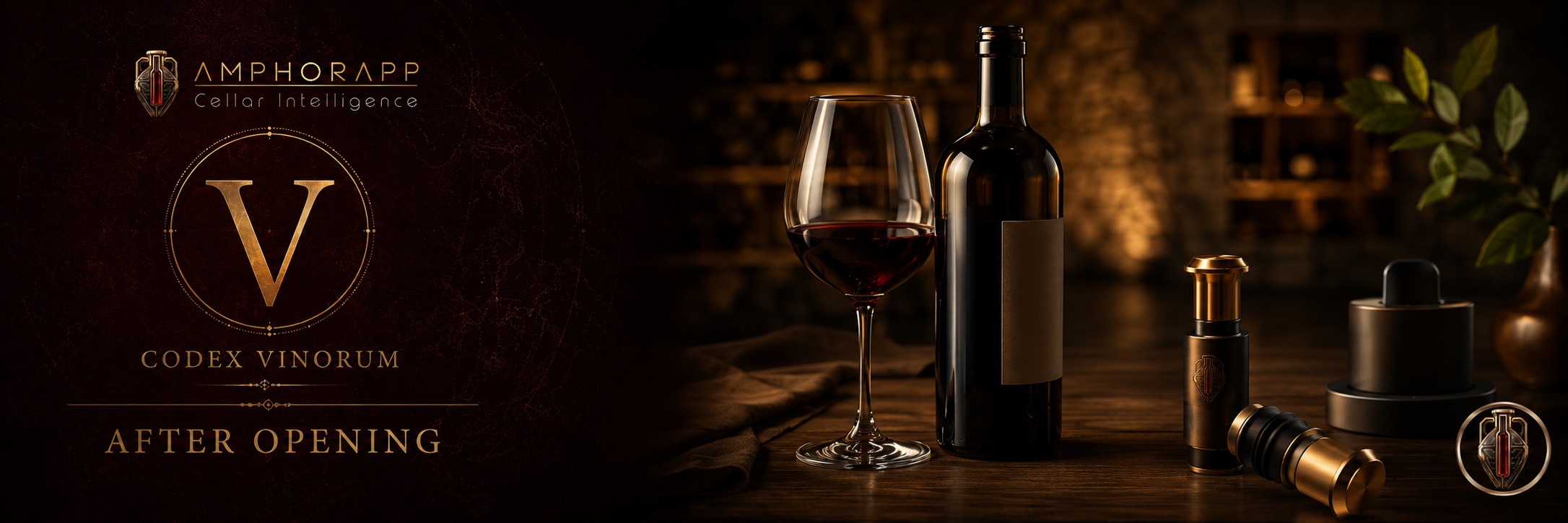
Once a bottle is opened, oxygen begins changing its aromas, color and flavor. Some wines improve briefly with air; others decline quickly. Always refrigerate an opened bottle, including red wine — cold slows oxidation and microbial activity. Bring red wine back toward serving temperature before drinking.
These are reference ranges, not guarantees — an old, fragile wine may decline within hours, while a young structured wine may remain sound longer.
Reduces, doesn't remove
Reduces further air exchange but doesn't remove oxygen already in the bottle.
Retains pressure
Mechanically seals the bottle and helps retain pressure.
Results vary
Removes some headspace air but doesn't create a complete vacuum — repeated pumping can remove volatile aromas.
Argon or nitrogen
Gas systems displace oxygen above the wine and can extend preservation.
Reduces headspace
Moving wine into a clean, smaller bottle with minimal headspace reduces oxygen exposure effectively.
For valuable bottles
Passes a needle through natural cork and replaces removed wine with inert gas — can preserve the rest for extended periods when used correctly.
Signs an opened wine has deteriorated: flattened or faded fruit, bruised-apple or nutty notes where inappropriate to the style, browning, increased volatile acidity, loss of freshness, stale aroma, disappearing bubbles, or unexpected microbial or solvent-like notes.
Opening and serving
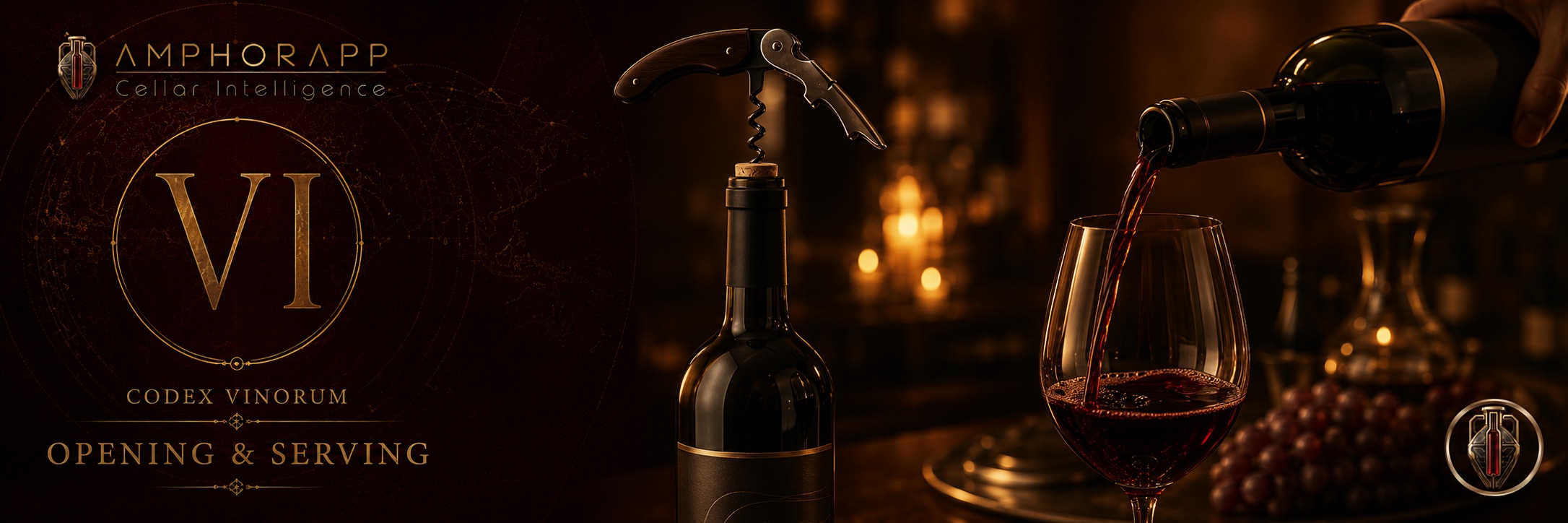
Still wine. Present the bottle and confirm producer, wine, vintage and appellation. Cut the capsule below the bottle lip. Wipe the neck. Insert the corkscrew centrally. Remove the cork slowly and quietly. Inspect the cork only as supporting information — it doesn't determine wine quality by itself.
Wipe the neck again. Smell and taste the wine in a clean glass. For old or fragile corks, use a two-prong opener, a combined cork extractor, or a heated-tong method only with appropriate training.
Sparkling wine. Chill the bottle properly. Dry the exterior if wet. Remove the foil. Keep a thumb over the cork. Loosen the wire cage without losing control of the cork. Hold the bottle at about 45 degrees, pointed away from people and fragile objects. Hold the cork firmly and rotate the bottle — not the cork. Let the pressure release with a controlled sigh, not an explosive pop.
Pouring. Keep the label visible when presenting the bottle. Avoid touching the neck to the glass. Don't overfill. Wipe drips discreetly. Serve water alongside wine. Adapt the order to hospitality and context rather than outdated gender rules.
When several wines are served, a useful progression is: delicate before powerful; dry before sweet; lower alcohol before higher alcohol; youthful before mature, unless the older wine is fragile; lightly aromatic before intensely aromatic; simple before complex; sparkling before still, when appropriate; whites before reds only when intensity supports that order.
There are exceptions — a powerful oaked white may follow a light red, and a delicate mature red may need to precede a concentrated young white.
Decanting and aeration
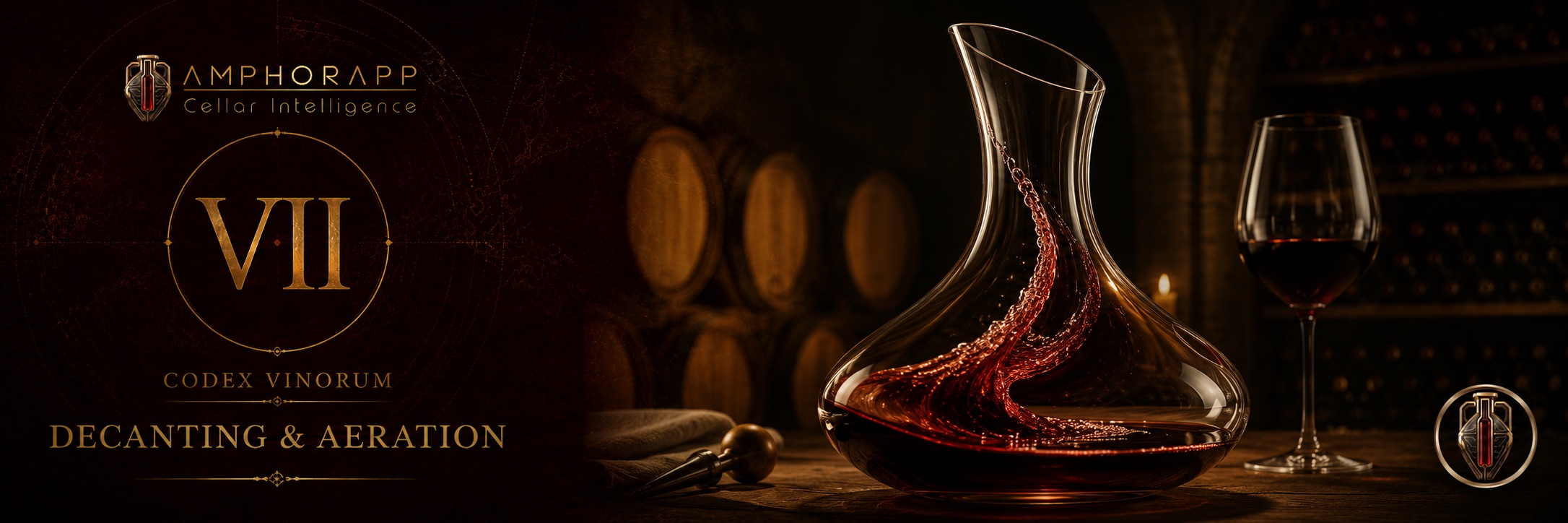
Decanting and aeration are related but not identical.
Separate the sediment
Objective: separate clear wine from sediment. Common for aged reds, vintage Port, unfiltered wines and wines with substantial sediment. Method: stand the bottle upright in advance so sediment can settle; open carefully; use a clean decanter; pour slowly with a light behind the shoulder or neck; stop when sediment approaches the neck. Fragile old wines shouldn't remain in a broad decanter longer than necessary.
Expose to oxygen
Objective: expose wine to oxygen to alter aromatic expression and texture. Potentially useful for young structured reds, reductive wines, concentrated whites, orange wines and selected natural wines. May release closed aromas, reduce some sulfur-related notes, change perceived astringency, reveal faults — or accelerate deterioration. It doesn't literally remove or chemically "soften" tannin immediately; it can change how structure is perceived.
Exercise caution with very old wines, delicate Pinot Noir, mature Burgundy, fragile aged Nebbiolo, wines already showing oxidation, and aromatic wines that fade quickly. There's no universal decanting time — "thirty minutes," "two hours" or "four hours" can't be applied to every wine. Taste periodically: immediately after opening, after 15 minutes, after 30 minutes, and at longer intervals when necessary.
Pairing: a method, not a fixed chart
Pairing works best when you consider the full preparation, not just the main ingredient — a grilled chicken breast, chicken curry, fried chicken and chicken in cream sauce all call for different wines, even with the same protein.
The simplest logic is still balancing weight with weight — light dishes call for light wines, intense dishes call for wines with more body — but ten variables, together, form a more complete method:
If the ten variables feel like a test, start with two: what dominates the plate, and whether the wine is lighter or heavier than the food.
Match intensity to body
The dish's intensity should meet the wine's body.
Acid calls for acid
Acidic dishes generally need wines with equal or greater perceived acidity.
Acidity, bubbles and tannin
Acidity, bubbles and — in appropriate dishes — tannin can refresh the palate after fatty foods.
Softens tannin and bitterness
Salt can soften the perception of tannin and bitterness while increasing fruit expression.
The wine should be as sweet as the dish
The wine should usually be at least as sweet as the dish — a dry wine beside a sweet dessert may taste thin, bitter or sharply acidic.
Less alcohol, more fruit
High-alcohol, tannic wines can intensify chili heat; lower alcohol, fruit and modest residual sugar often work better.
Can amplify tannin and bitterness
Umami can make wine seem more tannic, bitter or acidic; salt, fat and sauce components may rebalance the combination.
Bitter with bitter, with care
Bitter food and tannic wine may amplify one another.
Each technique, an intensity
Grilling, roasting, smoking, frying, poaching and braising create different flavor intensities and textures.
Often matters more than the protein
The sauce often matters more than the dish's main ingredient.
See the full guide, by category:
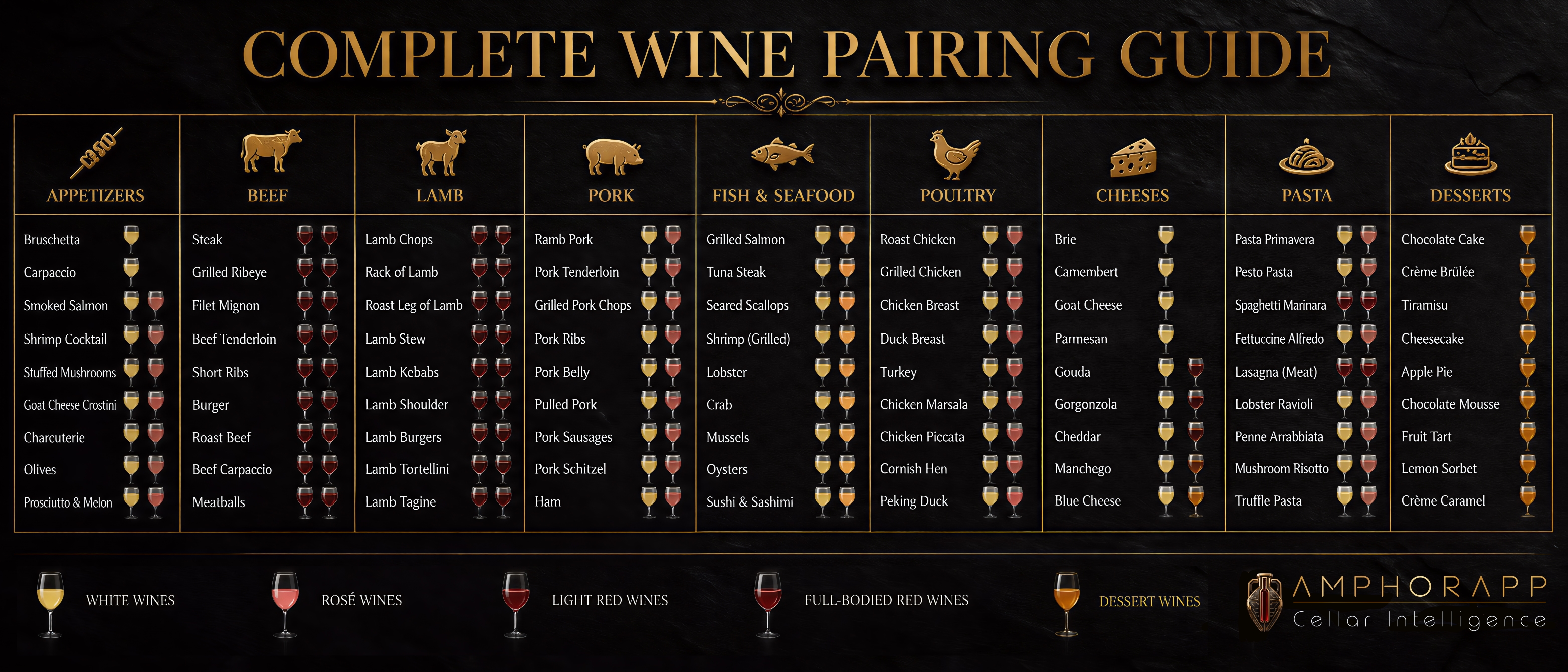
Nine categories, straight from our pairing guide — match any dish with the ideal wine style before you even open the bottle. Inside Amphorapp, this same logic runs automatically against every bottle in your own cellar, suggesting the right match for whatever’s on your plate today.
Starters and salads
Sparkling wine works well with fried starters, because acidity and bubbles refresh the palate. High-acid whites suit ceviche and citrus-based preparations. Vinegar can make a low-acid wine seem flat. Delicate salads call for wines without excessive oak, alcohol or tannin.
Beef
Consider the cut, fat, cooking point, char and sauce. Lean filet: medium-bodied reds or structured whites with savory sauces. Ribeye and short rib: structured reds with acidity and tannin. Tartare and carpaccio: light reds, rosé sparkling or high-acid whites. Braised beef: mature reds or concentrated medium-bodied reds.
Lamb
Herbs, fat and roasting method matter greatly. Herb-crusted lamb: Syrah, Cabernet Franc, Rioja-style reds. Slow-cooked lamb: structured reds with savory development. Delicate lamb loin: medium-bodied reds rather than maximum power.
Pork
Pork ranges from lean and delicate to rich and smoky. Pork loin: Chardonnay, Chenin Blanc, Pinot Noir. Pork belly: sparkling wine, high-acid whites or fresh reds. Sweet glazes: wines with matching fruit and modest sweetness. Smoked pork: Syrah, Grenache, dry rosé or aromatic whites.
Fish and seafood
Cooking method and sauce are decisive. Oysters: high-acid whites, Muscadet-style wines or sparkling. White fish: light whites. Rich fish such as salmon: fuller whites, rosé or light reds. Tuna: rosé, light reds or structured whites. Shellfish in cream sauce: full-bodied whites. Spicy seafood: aromatic, lower-alcohol whites. Avoid heavily tannic reds with delicate seafood — a metallic or bitter perception may emerge.
Poultry
Roast chicken: Chardonnay, Pinot Noir, Gamay. Duck: Pinot Noir, Nebbiolo, Syrah or structured rosé. Turkey: medium-bodied whites or reds. Spicy poultry: aromatic whites with moderate alcohol. Cream sauces: textured whites. Tomato-based sauces: high-acid reds.
Cheese
Pair by texture, salt, intensity and ripeness rather than color alone. Fresh goat cheese: Sauvignon Blanc and other high-acid whites. Brie and Camembert: sparkling wine, Chardonnay, light reds. Aged hard cheese: structured reds, oxidative whites or fortified wines. Blue cheese: sweet or fortified wine. Washed-rind cheese: aromatic whites, Belgian-style beers or selected mature reds.
Pasta
The sauce is more important than the pasta. Tomato: high-acid reds. Cream: textured whites. Pesto: herbal whites or light reds. Seafood: high-acid whites. Ragù: medium or full-bodied reds. Cacio e pepe: textured whites, sparkling or medium-bodied reds. Arrabbiata: fruit-driven reds with moderate alcohol.
Desserts
The wine should normally be as sweet as or sweeter than the dessert. Fruit desserts: Moscato, late-harvest whites, sweet sparkling. Custard and crème brûlée: Sauternes-style wines, Tokaji, Vin Santo. Coffee desserts: Tawny Port, Madeira, Marsala. Dark chocolate: Banyuls, Maury, Ruby Port or selected sweet red wines. Caramel and nuts: Tawny Port, Madeira, Vin Santo. Blue cheese: Sauternes, Tokaji, Port.
Amphorapp's pairing logic
A technically credible recommendation evaluates, on the wine's side: sweetness, acidity, tannin, alcohol, body, aromatic intensity, carbonation, oak and maturity; and on the dish's side: weight, fat, salt, sweetness, acidity, bitterness, umami, spice, cooking method and sauce intensity. Every recommendation explains why the match works and identifies suitable alternatives.
How to read the label: classifications and terminology
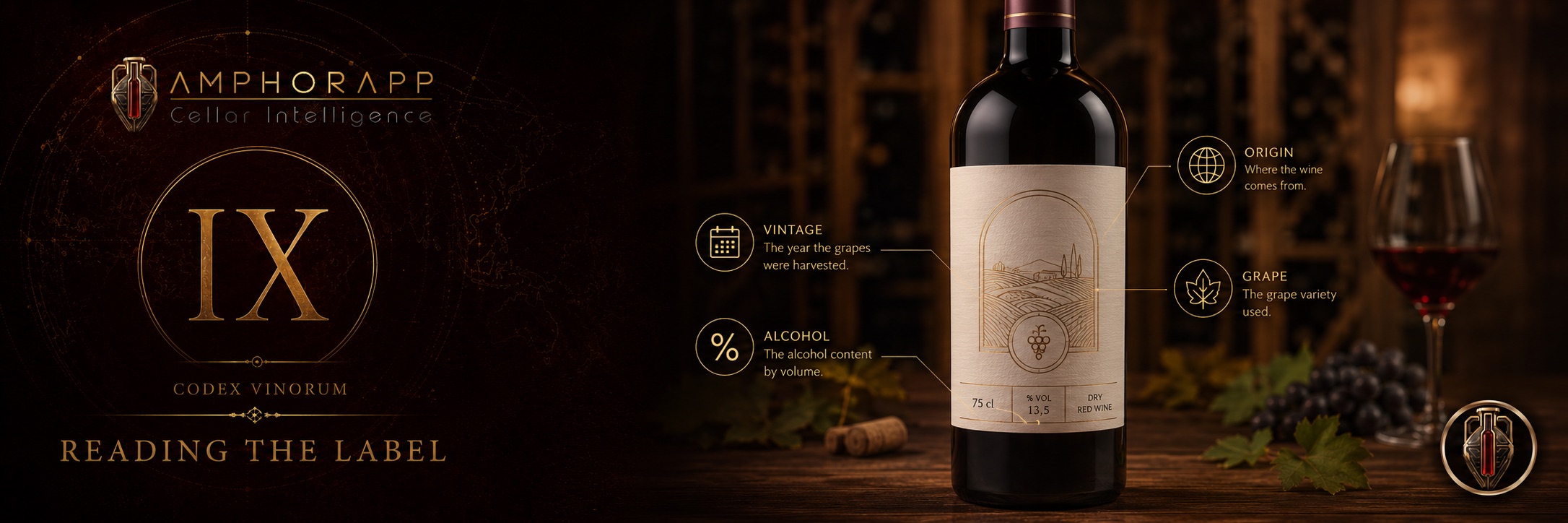
To choose, four clues are enough: who made it, where, from which grape or style, and in which year. The terms below explain what those words mean in law.
Alcohol, sugar, and terms like "Reserve" or "Grand Cru" carry precise technical information — but it doesn't all come from the same source. Alcohol content and sugar classification largely follow OIV (International Organisation of Vine and Wine) definitions; terms like Cru, Reserve or Riserva depend on each country's or appellation's own law. Here's what each one actually means — and where that information comes from.
International technical standard
Amphorapp uses the OIV — International Organisation of Vine and Wine — as its primary reference for international definitions, analytical parameters and oenological terminology. Where no international standard applies, we explicitly identify the country, jurisdiction or appellation responsible. Practical style ranges are presented as editorial guidance, not legal classification.
What a label can communicate
Producer, brand, wine name, grape variety, geographic origin, appellation, vintage, alcoholic strength, net volume, lot, bottler, importer, allergens, sugar category, production or aging terms, sustainability certification, and nutritional or ingredient information where required. Not every item appears on the front label — requirements vary by jurisdiction.
The grape in the spotlight
Examples: Riesling, Chardonnay, Cabernet Sauvignon, Malbec. The percentage required for a varietal claim depends on the applicable jurisdiction.
The origin in the spotlight
Examples: Chablis, Barolo, Rioja, Chianti Classico, Bordeaux, Sancerre. Understanding the region often reveals which grapes and production rules are permitted.
Brand or cuvée
The wine uses a brand or cuvée name — it may be a blend, or a wine whose identity isn't communicated primarily through variety or appellation.
When the place name tells you the grape(s)
Many European appellations, and a few regulated designations beyond Europe, legally require one grape or a traditional set of grapes. The name on the label works as a regulated shorthand: the place carries the variety, or the blend the law allows. Amphorapp uses these official mappings when the label does not declare the grape. A figure on a card is a minimum or a range written in the disciplinare or the cahier des charges, usually as the composition of the estate's vineyards. It is the legal floor. It is the share the rule allows, and it is not a laboratory reading of one bottle. Where the law leaves the proportion open, the card lists the authorized grapes and stops there.
All keeps a short curated set on screen. Italy, France, Spain and Other open every card for that country.
Single variety
Some of these names admit only one grape. The badge “100% by law” means no other variety is authorized in that wine. “Style on the label” is a different case: Champagne Blanc de Blancs is white grapes only, and in practice that grape is Chardonnay, while a few other white varieties remain legal and rare.
Barolo and Barbaresco DOCG, Piedmont
Nebbiolo, 100%.
Official rule
Both denominations admit Nebbiolo alone. Barolo covers eleven communes of the Langhe. Barbaresco covers Barbaresco, Neive and Treiso. Aging — 38 months for Barolo, 62 for Barolo Riserva, 26 months for Barbaresco — is a separate rule, already set out above, and it leaves the grape unchanged.
Source: disciplinare di produzione, Barolo DOCG and Barbaresco DOCG.
Brunello di Montalcino and Rosso di Montalcino DOCG and DOC, Tuscany
Sangiovese, 100%.
Official rule
Brunello di Montalcino DOCG is Sangiovese alone, with the long aging the denomination requires. Rosso di Montalcino DOC is the same grape, released earlier. A Toscana IGT from the same cellar is another wine, and it does not inherit this rule.
Source: disciplinare di produzione, Brunello di Montalcino DOCG and Rosso di Montalcino DOC.
Montefalco Sagrantino DOCG, Umbria
Sagrantino, 100%.
Official rule
The dry wine and the passito are both Sagrantino alone. Montefalco Rosso is a different denomination, a blend, and this rule does not cover it.
Source: disciplinare di produzione, Montefalco Sagrantino DOCG.
Nizza DOCG, Piedmont
Barbera, 100%.
Official rule
Nizza DOCG admits Barbera alone. Barbera d'Asti is a wider denomination, and its own disciplinare is the text that applies there.
Source: disciplinare di produzione, Nizza DOCG.
Dogliani and Diano d'Alba DOCG, Piedmont
Dolcetto, 100%.
Official rule
Dogliani DOCG is Dolcetto alone. Diano d'Alba DOCG, still met on labels as Dolcetto di Diano d'Alba, is Dolcetto alone. Dolcetto d'Alba DOC is a broader denomination, with its own rule.
Source: disciplinare di produzione, Dogliani DOCG and Diano d'Alba DOCG.
Cornas AOC, northern Rhône
Syrah, 100%.
Official rule
Cornas is the northern Rhône appellation whose red wine is Syrah alone. Hermitage and Crozes-Hermitage, a short distance north, allow a share of Marsanne and Roussanne. The difference is written in the cahiers des charges.
Source: cahier des charges, Cornas AOC.
Condrieu and Château-Grillet AOC, northern Rhône
Viognier, 100%.
Official rule
Condrieu admits Viognier alone. Château-Grillet is its own appellation, a single estate on the same slope, and it is Viognier alone as well.
Source: cahier des charges, Condrieu AOC and Château-Grillet AOC.
Chablis, Meursault and Puligny-Montrachet, white AOC, Burgundy
Chardonnay, 100%.
Official rule
Petit Chablis, Chablis, Chablis Premier Cru and Chablis Grand Cru are Chardonnay. The white wines of Meursault and Puligny-Montrachet, including their Premiers Crus and the Grand Cru climats that carry those villages, are Chardonnay. Where those villages make a red, the grape is Pinot Noir, and that red is a small part of the appellation. The regional appellation Bourgogne blanc is a wider text, and other grapes can enter it.
Source: cahiers des charges of the appellations named.
Côte de Nuits and Côte de Beaune, red Village and cru AOC, Burgundy
Pinot Noir, 100%.
Official rule
The communal red wines of the Côte de Nuits and the Côte de Beaune — Gevrey-Chambertin, Chambolle-Musigny, Vosne-Romanée, Volnay, Pommard and their peers, with their Premiers Crus and Grands Crus — are Pinot Noir. The regional appellation Bourgogne rouge is another text: in the Yonne, César may be used as an accessory grape.
Source: cahiers des charges of the village and cru appellations.
Beaujolais crus AOC
Gamay, 100%.
Official rule
Morgon, Fleurie, Moulin-à-Vent and the other crus are Gamay noir à jus blanc. Beaujolais and Beaujolais-Villages red follow the same grape. Beaujolais Blanc is another wine, made from Chardonnay.
Source: cahiers des charges, Beaujolais crus.
Sancerre blanc and Pouilly-Fumé AOC, Loire
Sauvignon Blanc, 100%.
Official rule
White Sancerre is Sauvignon Blanc. Pouilly-Fumé, across the Loire, is Sauvignon Blanc. Pouilly-Fuissé belongs to Burgundy, and its grape is Chardonnay.
Source: cahiers des charges, Sancerre AOC and Pouilly-Fumé AOC.
Sancerre rouge and rosé AOC, Loire
Pinot Noir, 100%.
Official rule
Red and rosé Sancerre are Pinot Noir. The color printed on the label changes the grape. White Sancerre, the historical body of the appellation, remains Sauvignon Blanc.
Source: cahier des charges, Sancerre AOC.
Vouvray AOC, Loire
Chenin Blanc, 100%.
Official rule
Still, sparkling and sweet Vouvray are Chenin Blanc. Sec, demi-sec, moelleux and the sparkling styles change the sugar and the bubbles. The grape stays Chenin Blanc.
Source: cahier des charges, Vouvray AOC.
Champagne Blanc de Blancs AOC, style mention
White grapes only. In practice, Chardonnay.
Official rule
Blanc de Blancs means the wine is made from white grapes alone. Chardonnay is the grape used. Arbane, Petit Meslier, Pinot Blanc and Pinot Gris remain authorized, and they are rare. The mention is read before a generic Champagne blend. Voltis, a variety admitted for adaptation, stays inside the limits set out on the Champagne card below.
Source: cahier des charges, Champagne AOC.
Dominant variety, with a legal tolerance
The place still names the grape, and the law writes a minimum rather than a single variety. The bar marks that minimum. The line under the bar repeats the rule in words, so the figure does not depend on color. A bottle may sit anywhere from that floor up to 100%, unless a maximum is also written.
Roero, red DOCG, Piedmont
Nebbiolo, at least 95%.
Official rule
Roero rosso and Roero Riserva are Nebbiolo at a minimum of 95%. Up to 5% may be other non-aromatic red varieties authorized in Piedmont. Roero Arneis, including Riserva and spumante, is a white wine: Arneis at a minimum of 95%, with up to 5% other non-aromatic Piedmont whites. The word that follows Roero decides the grape.
Source: disciplinare di produzione, Roero DOCG.
Gattinara DOCG, Piedmont
Nebbiolo (Spanna), 90–100%.
Official rule
Gattinara is Nebbiolo, locally called Spanna, from 90% to 100%. Vespolina may contribute at most 4%. Vespolina and Uva Rara together stay within 10%.
Source: disciplinare di produzione, Gattinara DOCG.
Ghemme DOCG, Piedmont
Nebbiolo, at least 85%.
Official rule
Ghemme is based on Nebbiolo (Spanna). Vespolina and Uva Rara, also called Bonarda Novarese, may be used alone or together up to 15%.
Source: disciplinare di produzione, Ghemme DOCG.
Taurasi DOCG, Campania
Aglianico, at least 85%.
Official rule
Taurasi is Aglianico. Other non-aromatic red varieties authorized for the province of Avellino may contribute up to 15%. The complement is provincial. It is drawn from Avellino, which is the zone the disciplinare names.
Source: disciplinare di produzione, Taurasi DOCG.
Soave, including Classico DOC, Veneto
Garganega, at least 70%.
Official rule
Soave, including the Classico subzone, is Garganega at a minimum of 70%. Trebbiano di Soave, the local name of Verdicchio, and Chardonnay may together reach 30%. Inside that 30%, other non-aromatic white varieties of the province of Verona may reach 5%. A bottle may be Garganega alone. The law writes a floor, and it leaves the complement optional.
Source: disciplinare di produzione, Soave DOC.
Vino Nobile di Montepulciano DOCG, Tuscany
Sangiovese (Prugnolo Gentile), at least 70%.
Official rule
Vino Nobile di Montepulciano is Sangiovese, locally Prugnolo Gentile, at a minimum of 70%. Complementary varieties suitable for cultivation in Tuscany may reach 30%, and white grapes inside that share may not pass 5%. Aromatic varieties are excluded, with the exception of Malvasia Bianca Lunga. The mention Pieve tightens the rule: Sangiovese at a minimum of 85%, and the complement limited to Canaiolo Nero, Ciliegiolo, Mammolo and Colorino, together up to 15%, with Colorino at most 5%.
Source: disciplinare di produzione, Vino Nobile di Montepulciano DOCG, as amended in 2025.
Côte-Rôtie AOC, northern Rhône
Syrah, at least 80%.
Official rule
Côte-Rôtie is Syrah at a minimum of 80% of the estate's encépagement and of the assemblage. Viognier may be planted among the Syrah, up to 20% of the vines. When both grapes are used, they are vinified together, at that same proportion. Many bottles are Syrah alone. The law allows the Viognier. It leaves the choice with the estate.
Source: cahier des charges, Côte-Rôtie AOC.
Hermitage and Crozes-Hermitage, red AOC, northern Rhône
Syrah, at least 85%.
Official rule
Red Hermitage and red Crozes-Hermitage are Syrah at a minimum of 85%. Marsanne and Roussanne may be planted among the Syrah, up to 15% of the vines, and they are vinified with it. The white wines of both appellations are Marsanne and Roussanne. Cornas, nearby, is Syrah alone.
Source: cahiers des charges, Hermitage AOC and Crozes-Hermitage AOC.
Classic assemblage
Here the law authorizes a set of grapes, or a range, and the label rarely prints a percentage. The card lists what the rule allows. It does not assign a share to a given bottle. Where a minimum exists, it is stated as a minimum.
Champagne AOC, without a style mention
Chardonnay, Pinot Noir and Pinot Meunier, plus four historic varieties that remain rare.
Official rule
A Champagne that does not say Blanc de Blancs or Blanc de Noirs draws on the principal varieties: Chardonnay, Pinot Noir, Meunier, and also Arbane, Petit Meslier, Pinot Blanc and Pinot Gris. No percentage is printed, and none is inferred. Blanc de Noirs restricts the wine to the black grapes, Pinot Noir and Meunier. Blanc de Blancs has its own card above. Since the cahier des charges homologated on 25 January 2024, Voltis, a variety admitted for adaptation, may cover at most 5% of the estate's plantings and 10% of the blend, and only under the convention the INAO requires. The seven principal varieties remain at least 95% of the plantings.
Source: cahier des charges, Champagne AOC, arrêté of 25 January 2024.
Bordeaux red, by bank AOC
Cabernet Sauvignon, Merlot, Cabernet Franc, Petit Verdot, Carménère and Malbec. No legal percentage.
Official rule
The communal appellations of the Médoc — Margaux, Pauillac, Saint-Julien, Saint-Estèphe, together with Médoc and Haut-Médoc — authorize Cabernet Sauvignon, Merlot, Cabernet Franc, Petit Verdot, Carménère and Malbec, and they fix no share. The historical wines of the Left Bank lead with Cabernet Sauvignon. On the Right Bank, Saint-Émilion and Pomerol lead, in the glass and in the vineyard, with Merlot and Cabernet Franc. That lead is a habit of the place. The cahier des charges does not impose it. White Bordeaux is another wine, from Sauvignon Blanc, Sémillon and Muscadelle.
Source: cahiers des charges of the Bordeaux appellations.
Chianti Classico DOCG, Tuscany
Sangiovese, 80–100%.
Official rule
Chianti Classico and Chianti Classico Riserva are Sangiovese from 80% to 100%. Other red varieties authorized in Tuscany may cover up to 20% of the registered vineyard area. Canaiolo Nero and Colorino are the historical companions. Cabernet Sauvignon, Merlot, Syrah and further Tuscan reds are also on that authorized list, inside the same 20%. Gran Selezione tightens the rule to Sangiovese from 90% to 100%, and the complement is limited to Colorino, Canaiolo, Ciliegiolo, Mammolo, Pugnitello, Malvasia Nera, Foglia Tonda and Sanforte, up to 10% of the registered area. That stricter list applies from the fifth harvest after the amendment of 22 June 2023. Until then, vineyards that meet the 80% rule may still be used for Gran Selezione. Chianti without the word Classico is a different denomination, and it has its own grape rule.
Source: disciplinare di produzione, Chianti Classico DOCG, consolidated with the decree of 22 June 2023.
Amarone della Valpolicella DOCG, Veneto
Corvina and/or Corvinone 45–95%. Rondinella 5–30%. Other grapes up to 25%.
Official rule
The disciplinare composes the vineyard, within the estate, as Corvina Veronese — also called Cruina or Corvina — and/or Corvinone from 45% to 95%, and Rondinella from 5% to 30%. Other grapes may reach 25% in total. Inside that 25%, non-aromatic red varieties authorized in the province of Verona may reach 15%, with at most 10% of any one variety, and Italian autochthonous red varieties of the same province make up the remaining share, up to 10%. Recioto della Valpolicella DOCG uses this same composition. Valpolicella DOC is built from the same varieties. The dried-grape method of Amarone is a separate rule, and it leaves the varieties as the disciplinare wrote them.
Source: disciplinare di produzione, Amarone della Valpolicella DOCG.
Châteauneuf-du-Pape AOC, southern Rhône
Grenache, Syrah, Mourvèdre and the other authorized varieties. No legal minimum for Grenache.
Official rule
Thirteen historical names, eighteen if the color variants are counted apart, may enter the wine. Grenache is the historical majority. The cahier des charges does not require that majority. Syrah, Mourvèdre and Cinsaut are the other varieties most often met in the blend. A bottle may be Grenache alone, or a field blend. The label is not obliged to say which.
Source: cahier des charges, Châteauneuf-du-Pape AOC.
Rioja DOCa
Tempranillo, Garnacha, Graciano, Mazuelo and Maturana Tinta. No minimum for Tempranillo.
Official rule
Red Rioja authorizes Tempranillo, Garnacha Tinta, Graciano, Mazuelo and Maturana Tinta. Tempranillo is the historical spine of the region. The pliego de condiciones sets no minimum for it. A Rioja may be Garnacha alone, or Graciano alone. Reserva and Gran Reserva, explained in the aging section above, regulate time in cask and bottle. They leave the blend to the varieties the denomination already allows.
Source: pliego de condiciones, Rioja DOCa.
Priorat DOQ
Garnacha and Cariñena (Samsó) at the historical center. Other varieties are authorized. No fixed percentage.
Official rule
The historical vineyards are Garnacha Tinta and Cariñena, locally Samsó. Garnacha Peluda, Cabernet Sauvignon, Cabernet Franc, Merlot, Syrah and further authorized varieties may be used. The denomination fixes no share. A Priorat is read as that set of grapes.
Source: pliego de condiciones, Priorat DOQ.
Cava DO
Macabeo, Xarel·lo and Parellada, with other authorized varieties. No fixed percentage.
Official rule
The traditional base is Macabeo, Xarel·lo and Parellada. Chardonnay, Pinot Noir, Trepat, Garnacha Tinta, Monastrell and Subirat Parent are also authorized. A Cava may follow the historical three, or move inside the authorized list. The label is not obliged to print the share.
Source: pliego de condiciones, Cava DO.
Tokaj PDO, Hungary
Furmint, Hárslevelű, Sárgamuskotály, and the other authorized varieties.
Official rule
The authorized varieties include Furmint, Hárslevelű, Sárgamuskotály — Muscat Blanc à Petits Grains — together with Zéta, Kövérszőlő and Kabar. Furmint is the variety around which Tokaji Aszú was built. A bottle may be Furmint alone, as many dry wines now are, or a blend. The place name, by itself, fixes the authorized set. It leaves the percentage to the wine in the glass.
Source: product specification, Tokaj PDO.
Mosel, Rheingau and Nahe Germany
The region leaves the grape open. Riesling is the historical center.
Official rule
A wine labeled Mosel, Rheingau or Nahe is often Riesling, above all when an Einzellage or a Grosses Gewächs is named. German wine law asks the variety to be read from the label when the wine is sold as a varietal. Müller-Thurgau, Elbling and other authorized grapes remain legal in these regions. The VDP statute reserves Grosses Gewächs, in these classic regions, to Riesling. That statute belongs to the producers' association. The wine law of Germany is the text that governs every bottle naming the region.
Source: German wine law for the regional names; VDP classification statute for Grosses Gewächs.
How the mapping is applied
- The specific denomination prevails. Brunello di Montalcino fixes Sangiovese. A broader Toscana IGT on the same estate does not override that name.
- A generic indication stays flexible. Rosso di Toscana, Toscana IGT, Vin de France and their equivalents may list grapes that are authorized, or grapes that are probable. They never force one variety.
- A style mention on the label replaces the base appellation. Champagne Blanc de Blancs and Blanc de Noirs are read before the generic three-grape blend.
How Amphorapp reads a region-led label
When a bottle is scanned or entered as Barolo, Brunello or Champagne Blanc de Blancs, and the label does not declare the grape, the appellation is read against this mapping. Where the law fixes one variety, that variety is attached to the bottle. Where the law fixes a traditional blend and leaves the percentage open, the authorized grapes are listed, and no proportion is invented.
The place name has to name the wine. A grappa, a brandy, a vinegar, or a page that only sits near the village does not take the grape. A label that prints another variety beside the denomination, Barbera next to Barbaresco for example, is that other wine. On the white card above, Meursault and Puligny-Montrachet are Chardonnay. The red from those villages is Pinot Noir. Barolo Chinato is an aromatized wine built on Barolo, and the grape remains Nebbiolo. Pinot Noir and Pinot Nero are one grape written two ways. Prosecco Rosé and Passe-tout-grains are read against both names.
These regulated mappings are the practical reason a region-led label already tells you so much before you even open the bottle.
Typical alcohol ranges by style
These are practical reference ranges, not legal classifications — actual alcohol content varies with grape variety, climate, vintage, ripeness and winemaking. Internationally, alcohol content is expressed as % vol. (alcoholic strength by volume), measured by the OIV at the reference temperature of 20 °C; the English abbreviation ABV ("alcohol by volume") refers to the same measurement.
The OIV's general definition of wine sets a minimum actual alcoholic strength of 8.5% vol., while allowing regional legislation to reduce that minimum to 7% vol. in specified circumstances.
What determines alcohol: grape sugar at harvest, fermentation completion, enrichment or concentration where permitted, fortification, alcohol removal, climate, variety, vineyard yield, harvest date and winemaking decisions.
Alcohol isn't the only calorie source in wine: it provides roughly 7 kcal per gram, and residual sugar adds around 4 kcal per gram of its own — so total calories depend on both alcohol content and sugar, plus serving size and the wine's density and composition. Don't assign an exact calorie value to a bottle solely from its % vol. For an exact figure, check the producer's nutritional declaration or analytical data.
There's a visual tell for alcohol right in the glass: swirl the wine, tilt the glass slightly, and watch the "legs" run down the inside wall — but they're a hint, not a reliable measurement of alcohol content or quality, and they're also affected by glycerol, temperature and how clean the glass is.
Sugar and the sweetness scale
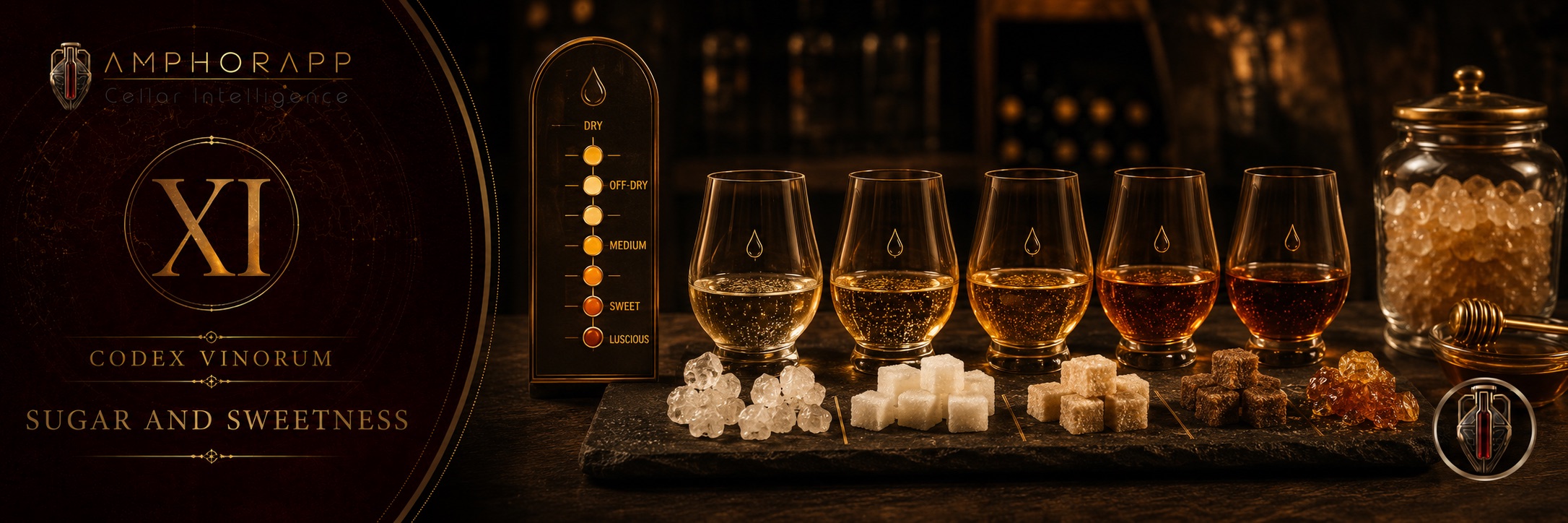
Sugar content is measured as the sum of glucose and fructose, in grams per liter (g/L). International sweetness categories follow OIV definitions — which, in some cases, also weigh the relationship between sugar and total acidity, since higher acidity can make a wine taste drier than the sugar figure alone would suggest. The ranges shift depending on whether the wine has bubbles:
* Under OIV rules, the "dry" threshold can reach 9 g/L, and "medium-dry" up to 18 g/L, when total acidity is no more than 2 g/L below the sugar content — so a more acidic wine can be classed as dry with slightly more residual sugar than the plain figure suggests.
Additional terms like Brut Nature (less than 3 g/L, with no sugar added after secondary fermentation) and Extra Brut (0–6 g/L) are widely used, but follow European Union and appellation-specific rules — they aren't part of the OIV's five basic international categories for sparkling wine.
That's why Brut — the world's most common sparkling style — sets a maximum sugar level, not a fixed amount: a Brut can sit well below the category's ceiling. If you want the lowest residual sugar possible, look for Brut Nature or Extra Brut.
Unlike alcohol and sugar — which follow international analytical parameters — terms like Cru, Reserve, Crianza, Riserva and Garrafeira depend on each country's or appellation's own law; no single international classification can replace them.
Origin and classification terms
There's no single global ladder for terms like Cru, Grand Cru, Premier Cru, Reserva, Riserva or Garrafeira. Their meaning depends on the country, region, appellation, classification system, wine color, production method, vintage and current legislation.
Cru literally means "grown" — it's commonly associated with a recognized growth, vineyard, site, estate or classified production unit, but its legal function changes by region; it shouldn't be translated simply as "quality-certified vineyard" in every context.
Burgundy
A useful introductory hierarchy is: Grand Cru → Premier Cru → Village → Regional. Grand Cru generally identifies the highest level among Burgundy's geographically delimited appellations — the vineyard or climat name is central, with production rules specific to that appellation. Premier Cru identifies officially recognized climats within certain village appellations (a label may read "Mercurey Premier Cru," or "Mercurey Premier Cru" plus the climat name). Village identifies wine from a defined communal appellation — examples include Mercurey, Meursault, Gevrey-Chambertin and Vosne-Romanée.
Regional covers broader Burgundy appellations, such as Bourgogne, Bourgogne Aligoté and Crémant de Bourgogne. This hierarchy describes geographic specificity and regulatory status — it doesn't guarantee that every Grand Cru will be preferred to every Premier Cru or village wine.
Bordeaux: parallel systems, not one ladder
Bordeaux doesn't have one universal sequence like "Grand Cru Classé → Cru Bourgeois → Appellation → Supérieur → Generic" — that representation is misleading. The 1855 Classification primarily covers classified estates of the Médoc, with Château Haut-Brion (from Graves) included, plus a separate classification for Sauternes and Barsac. The Saint-Émilion Classification is distinct and periodically revised, with its own rules and terminology. The Graves Classification is separate, associated with estates in Graves and present-day Pessac-Léognan. Cru Bourgeois is a Médoc classification system independent from the 1855 hierarchy. Cru Artisan is a separate Médoc designation with its own recognition framework.
Bordeaux also uses geographical appellations at different levels — broad regional, subregional, communal, and specific sweet-wine and specialist appellations. Bordeaux Supérieur is a regulated appellation with requirements beyond generic Bordeaux in specified areas — it isn't simply a universal "second-lowest tier" beneath every local appellation.
Aging and quality terms
Crianza → Reserva → Gran Reserva
These terms are regulated, but requirements vary by whether the wine is red, white or rosé, still or sparkling, and by appellation and regional rules. Spanish law sets general aging categories, while individual denominations may impose stricter or more specific requirements — never present one red-wine framework as applying to every Spanish wine.
As a reference: Crianza needs a minimum 2 years of age, with at least 6 months (12 in Rioja) in oak; Reserva, minimum 3 years, with at least 12 months in oak; Gran Reserva, minimum 5 years, with 18 months or more in oak and the rest in bottle. Always identify the wine type and appellation.
Riserva
Riserva doesn't mean "two additional years" throughout Italy. Each DOC or DOCG defines its own total aging period, time in wood, time in bottle, release date, analytical standards and production requirements — Riserva indicates compliance with additional aging or production requirements set by the individual appellation.
Examples like Barolo or Chianti Classico (standard Chianti: 1 year; Riserva: at least 2; standard Barolo: 38 months; Riserva: 62) must be treated explicitly as examples, not a national rule.
Reserva and Garrafeira
Reserva is a protected traditional term whose conditions depend on applicable Portuguese and regional regulations — it may involve vintage quality assessment, analytical criteria, sensory approval and minimum alcoholic strength relative to the appellation. Garrafeira is a regulated traditional term with defined aging conditions (for reds: minimum aging of 30 months, at least 12 in bottle; for whites: 12 months, at least 6 in bottle) — its meaning must be distinguished from special regional uses, including Madeira terminology.
Don't reduce it to one generic formula without citing the applicable product category and legal framework.
"Réserve" has no single legal definition
"Réserve" doesn't carry one universal legal aging definition across all French wines — in many contexts, it may just be a producer-created cuvée name, unless protected by a specific rule.
Terms without standardized legal meaning
"Reserve," "Barrel Select," "Private Selection" and similar expressions may have no standardized legal meaning in some markets. A prestigious-sounding term isn't necessarily a regulated classification.
Vintage, non-vintage and lot identification
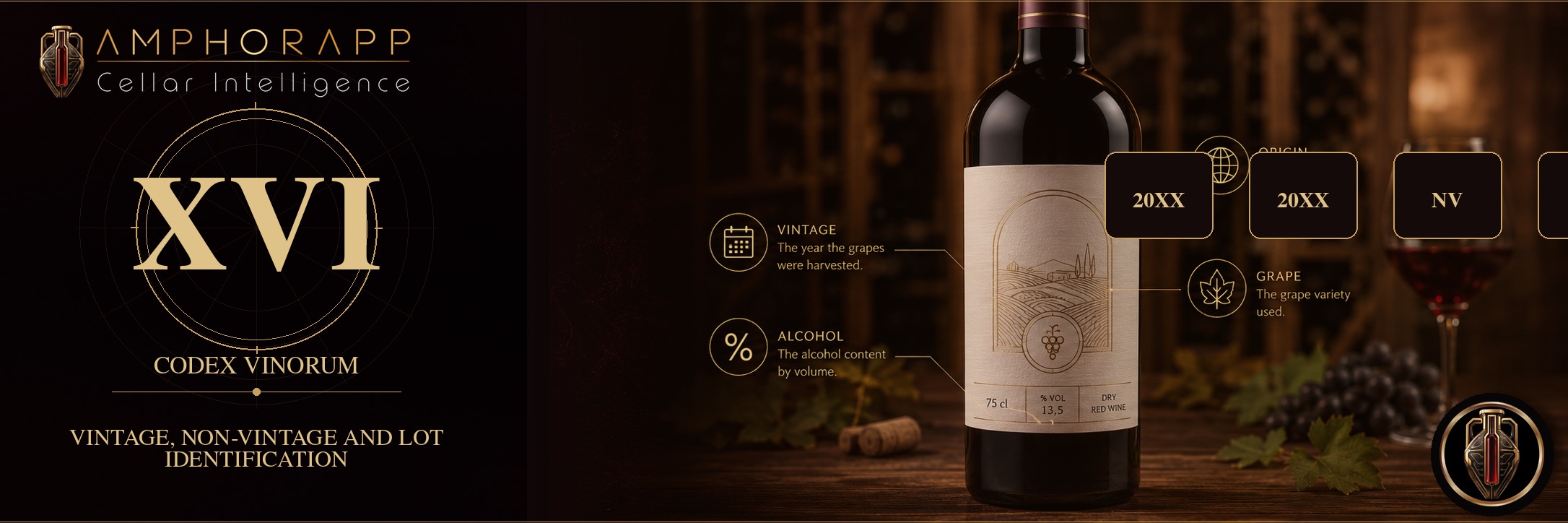
Vintage. Usually indicates the year the grapes were harvested, not necessarily the year of bottling or release. The percentage of wine that must come from the stated vintage varies by jurisdiction. Non-vintage. A wine blended from more than one harvest, or presented without a declared vintage — common in sparkling wine, fortified wine, solera-aged products and multi-vintage blends.
For a wine you will drink young, vintage is secondary. It matters more when the bottle is meant to age and the region's weather changes from year to year.
Lot number. Identifies a defined production batch and supports traceability. Bottled by. Labels may distinguish producer-bottled, estate-bottled, cooperative-bottled, merchant-bottled, contract-bottled, or imported and bottled locally — the exact terminology depends on law.
Geographic indications and appellations
An appellation can regulate combinations of geographic boundaries, permitted varieties, yields, vineyard practices, minimum ripeness, winemaking, aging, alcoholic strength, sugar, pressure, labeling and sensory approval. Common systems include PDO/PGI, AOP/IGP, DOC/DOCG/IGT, DO/DOCa, DOP/IGP, AVA, GI and WO — these systems aren't directly equivalent in every legal or qualitative respect. Geographic classification indicates origin and regulatory compliance; it doesn't automatically rank personal enjoyment.
International reference: OIV. Regional terms and legal classifications may vary by jurisdiction and appellation.
How to inspect a bottle before buying
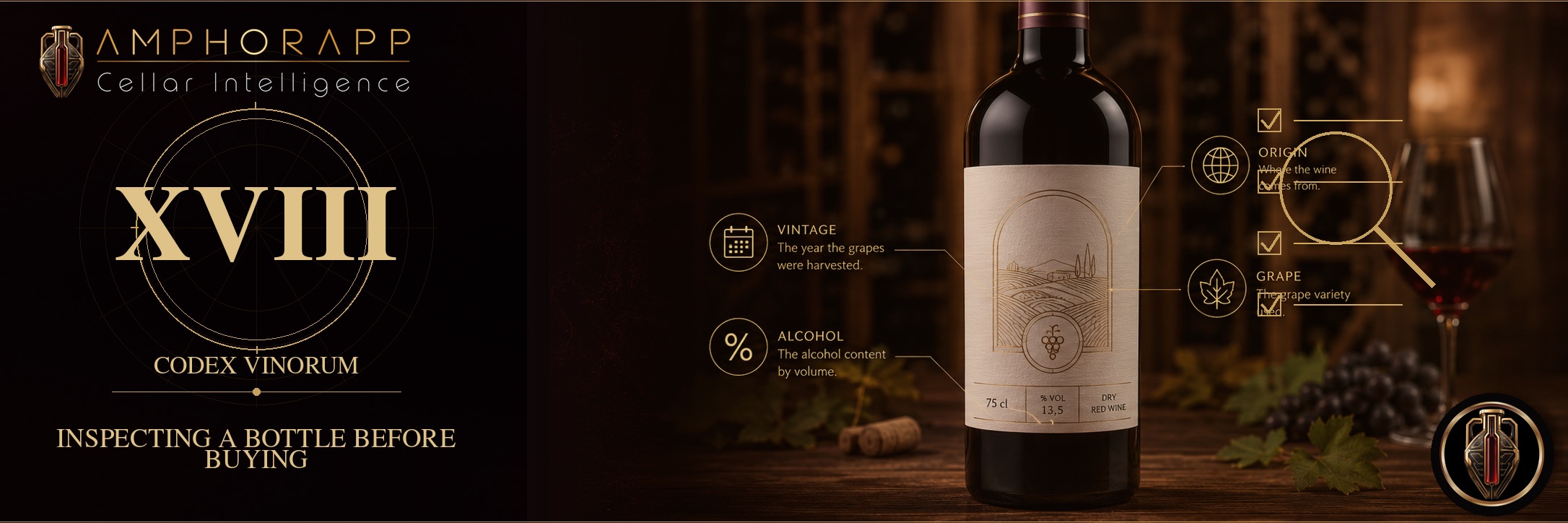
Check: fill level, signs of leakage, sticky residue near the capsule, a pushed or protruding cork, damaged closure, cracked glass, a faded or heat-damaged label, signs of storage under strong light, prolonged heat exposure, unusual sediment for the wine's age and style, provenance for valuable bottles, and consistency between label, capsule, glass and known producer packaging.
In older bottles, a low fill level can indicate evaporation, closure failure, storage history, or natural age-related loss — interpret fill level relative to the bottle's age and shape rather than by one universal rule. For rare or valuable wine, assess purchase history, invoices, chain of custody, importer, label typography, bottle mold, capsule, cork markings, and lot and serial data.
Sensory evaluation
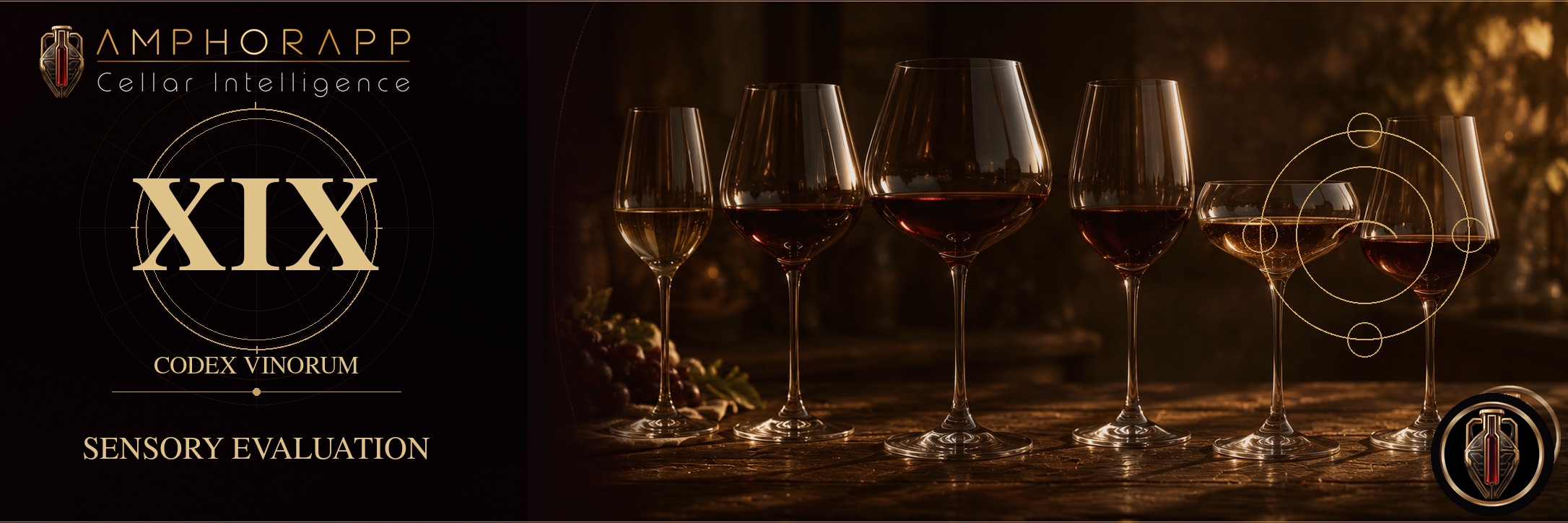
A reliable tasting method separates observation from conclusion.
Clarity, color, viscosity
Assess clarity, brightness, color, color intensity, rim variation, viscosity, bubbles and sediment. Avoid absolute claims — greater brightness doesn't always mean higher acidity, darker color doesn't always mean more body, a wider watery rim doesn't prove readiness, and smaller bubbles don't always mean better quality. Visual clues are contextual, not definitive.
Cleanliness, intensity, complexity
Assess cleanliness, intensity, aroma development, aromatic families, complexity, maturity, typicity and faults.
Sweetness, acidity, tannin, body
Assess sweetness, acidity, tannin, alcohol, body, carbonation, flavor intensity, texture, balance and finish.
The structural framework rounds out the evaluation: sweetness (from dry to sweet, based on analytical sugar and sensory perception), acidity (perceived through freshness, tartness and salivation), tannin (perceived primarily through astringency, a drying sensation and bitterness), alcohol (perceived through warmth, weight and aromatic lift), body (the overall tactile weight and density of the wine, resulting from the combined influence of alcohol, extract, sugar, glycerol, tannin and other components), and finish (the duration and quality of flavors and sensations after swallowing or spitting).
In usual white winemaking the juice is separated from the skins and the seeds before fermentation, so very little tannin passes into the wine. The white grape does hold tannin, mainly in the seeds and also in the skins. That property belongs to the grape. It is hardly transferred to a classical white wine, because fermentation happens without those solids. When a white wine is read, the tannin recorded for the grape is not the tannin of that wine. Orange wine, also called amber wine, is the exception: white grapes fermented with the skins, and sometimes the seeds or stems. That contact extracts tannin. The wine can show astringency, generally less than a red made the same way, because a white grape has less anthocyanin and the extracted tannin is less retained. A short rest of the juice on the skins before pressing is a different step: the juice is then fermented off the skins. A tannin scale already stored for a white grape remains a note on the grape. Where no scale is stored, the empty cell records fermentation without skins.
One comparison measures the grape, not the wine. In a single trial in Şanlıurfa, in the 2013 and 2014 vintages, Polat, Rastgeldi and Gürsöz (Viticulture Studies, 2022) measured total tannin by spectrophotometry, in milligrams per kilogram of fresh material, in the skin, the flesh and the seed. The two-year means were 448 mg/kg in the skin of the white varieties and 992 mg/kg in the colored varieties, 98 mg/kg and 143 mg/kg in the flesh, and 1602 mg/kg and 1584 mg/kg in the seeds. In that trial the seeds of white and colored grapes stood at the same level, and the seed was the main tannin reserve in both. The colored grapes held more tannin in the skin, a little more than twice the white mean, and somewhat more in the flesh, where both means stayed low. These figures belong to that place, those two vintages and that method. They are not the tannin of a wine. In classical white winemaking the juice ferments without prolonged contact with skins and seeds, so most of that tannin stays out of the wine. In red winemaking, maceration draws tannin from the skin and from the seeds.
Final conclusion: describe style, balance, intensity, complexity, typicity, readiness, aging potential, possible faults, overall quality and personal preference — personal preference and technical quality should remain separate.
Common wine faults
TCA
Often associated with damp cardboard, a moldy cellar or muted fruit.
Browning, flattened fruit
Can produce browning, bruised-apple notes, flattened fruit and loss of freshness when inappropriate to the style.
Struck match, rubber
May appear as struck match, rubber, cabbage, garlic or other sulfur-related aromas. Some reductive notes dissipate with air; others persist.
Vinegar, nail-polish remover
May resemble vinegar or nail-polish remover at excessive levels.
Leather, stable, smoke
Can generate leather, stable, medicinal or smoky aromas. Sensory tolerance varies, but high levels can suppress fruit and typicity.
Stewed fruit, premature aging
May cause leakage, pushed corks, stewed fruit and premature aging.
Cabbage, onion, sulfur
Especially relevant to sparkling and pale wines exposed to light — may produce cabbage-like, onion-like or sulfurous aromas.
Unexpected gas or cloudiness
Unexpected gas, pressure or cloudiness in a wine meant to be still may indicate microbial instability.
Not glass, not a fault
Harmless crystals formed from tartaric acid salts — they aren't glass and aren't a wine fault.
Common, not automatic evidence of spoilage
Common in aged, unfiltered or minimally processed wines — sediment isn't automatically evidence of spoilage.
Amphorapp technical intelligence
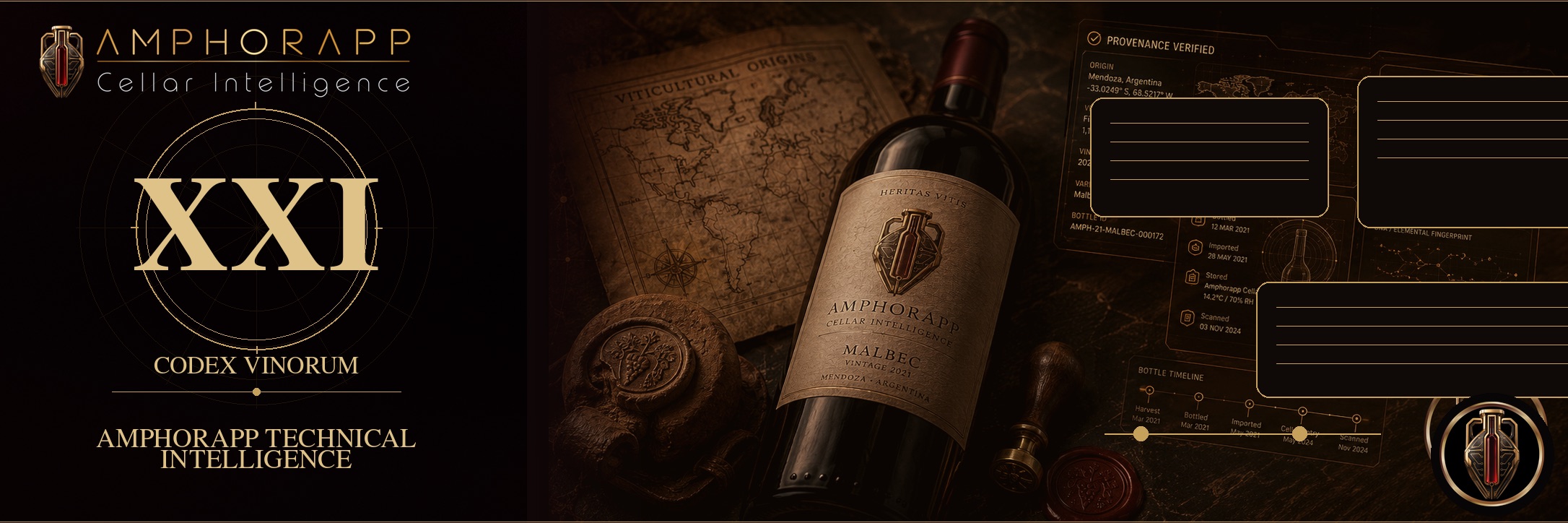
This practical guide shouldn't end as a static collection of charts. Inside Amphorapp, every bottle can connect to producer, vintage, grape varieties, origin, appellation, alcoholic strength, sugar category, ideal service temperature, glass recommendation, decanting guidance, pairing logic, drinking window, preservation after opening, cellar location, purchase provenance and tasting history.
Explainable recommendations
Every recommendation should show what is recommended, why it's recommended, which data supports it, what uncertainty remains, and which alternatives are suitable.
Example: "Recommended at 14–16 °C — this medium-bodied Pinot Noir combines high acidity, moderate tannin and delicate aromatic intensity. Serving it slightly cool preserves freshness while letting red-fruit and earthy aromas develop."
Example: "Pair with roast duck and berry sauce — the wine's acidity balances the fat, its moderate tannin avoids overpowering the meat, and its fruit profile echoes the sauce without adding excessive sweetness."
Editorial and regulatory note
International technical reference: International Organisation of Vine and Wine — OIV. Regional terminology: national, supranational and appellation rules apply where international definitions don't exist. Style ranges: practical guidance, not legal classification. Recommended review cycle: at least annually, or whenever a relevant regulation changes.
Take the Codex Vinorum with you
Amphorapp brings together this history, the science of terroir, and a complete pairing guide in one living library — scan a label and discover the origin, the provenance, and the right recommendation, instantly. This is just a preview: registered members get the full library of grape varieties and regions, personalized pairings, and a running history of every bottle in their cellar.
Start Standard